Civica
AI-powered legal support app for underprivileged women
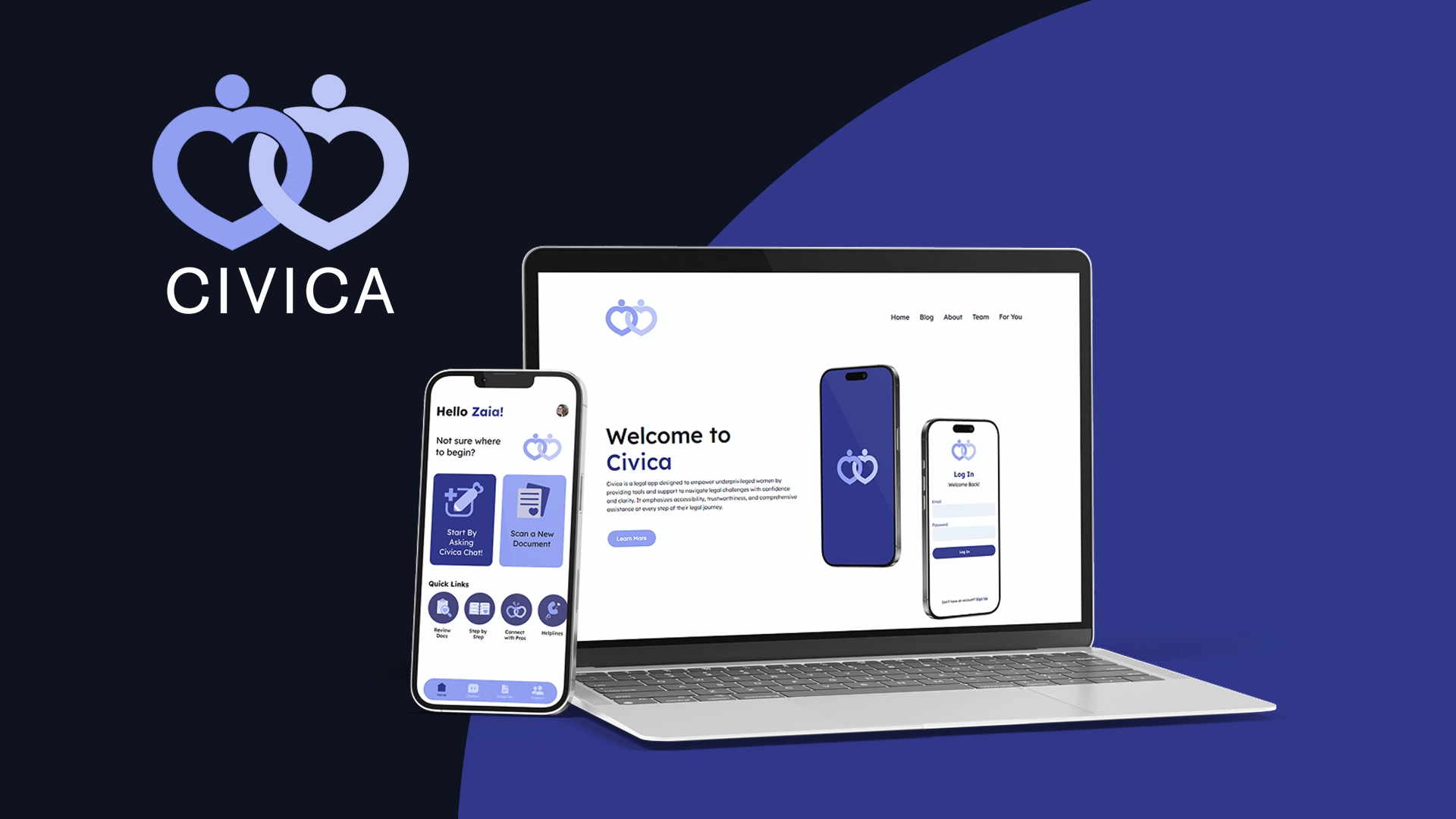
Overview
The Problem
Many underprivileged women face legal challenges without access to clear, affordable, and trustworthy legal support. Existing resources are often difficult to navigate, rely on complex legal language, and feel intimidating, which discourages users from taking action.
The challenge was to design a digital experience that reduces cognitive load, builds trust, and helps women understand and navigate legal processes with confidence.
Research & Discovery
Research indicates that access to legal support remains a significant barrier for women. One in two women report experiencing workplace harassment, and approximately 85% of vulnerable women are unable to access civil legal aid in Canada.
To better understand this problem space, the team conducted secondary research, reviewed seven legal case studies, and consulted with a practicing lawyer in British Columbia. This revealed recurring pain points: unclear processes, lack of guidance, and intimidation caused by legal language.
We made a deliberate decision not to interview women dealing with active legal issues. Asking them to relive those experiences would only have added to an already stressful situation, so we reframed the guiding question: rather than studying their stress, what could we build to help alleviate it?
Introducing Civica
Civica is an AI-powered legal support app designed to help underprivileged women navigate legal challenges with clarity and confidence. The app simplifies complex legal terminology, provides step-by-step guidance for common legal scenarios, and offers chatbot support alongside access to verified legal resources.
Civica was developed by an eight-member team of women and presented on December 6, 2024, to a panel of judges, instructors, and industry professionals.
Design & Iteration
Early usability testing and surveys revealed that while users valued the concept, the initial design lacked the seriousness expected from a legal application. Feedback highlighted issues with visual tone, hierarchy, and information architecture, all of which affected perceived credibility.
In response, the team iterated on layout, visual hierarchy, and navigation patterns. The result was Civica 2.0, a more refined experience aligned with user expectations for a legal support tool.
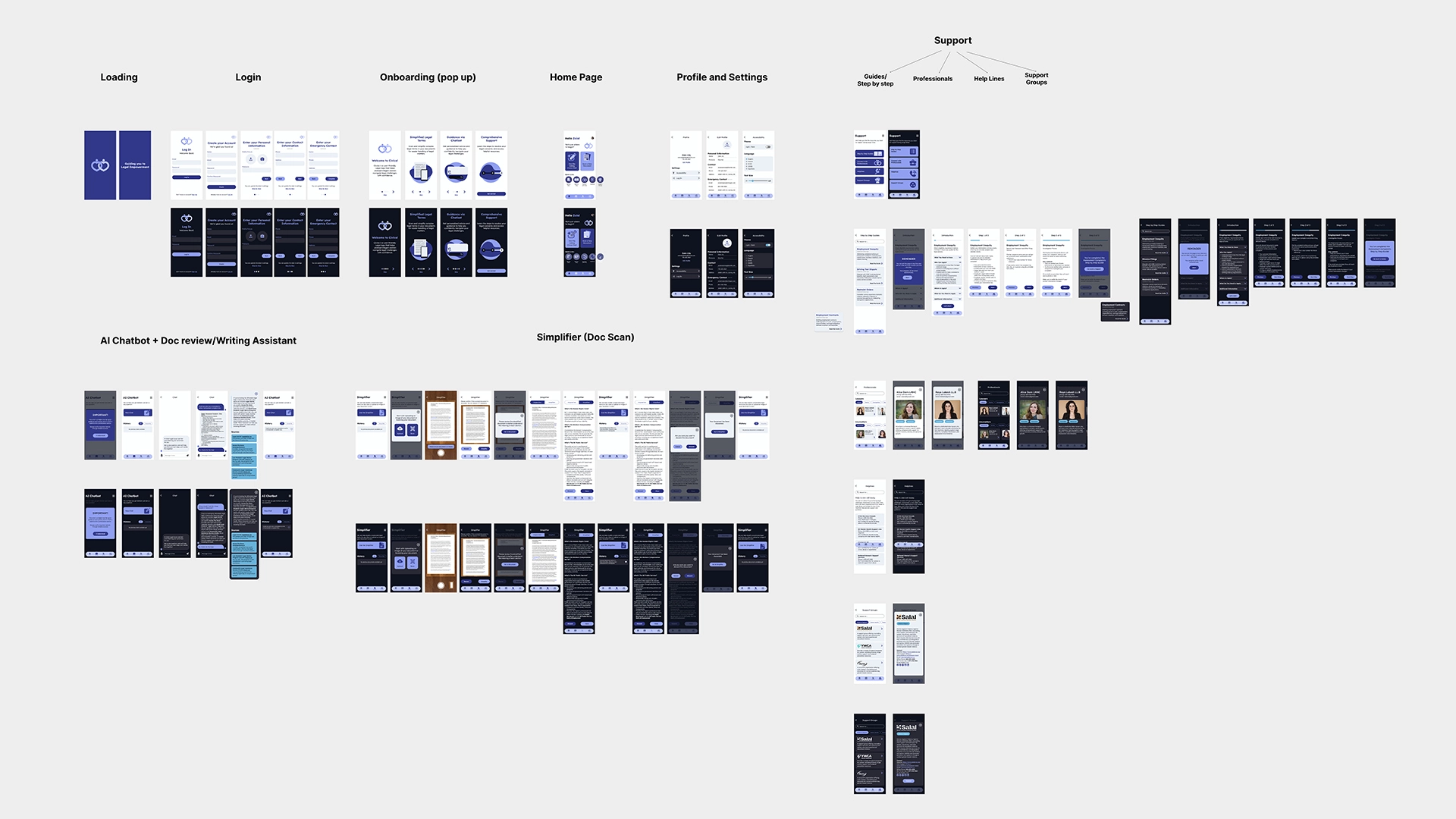
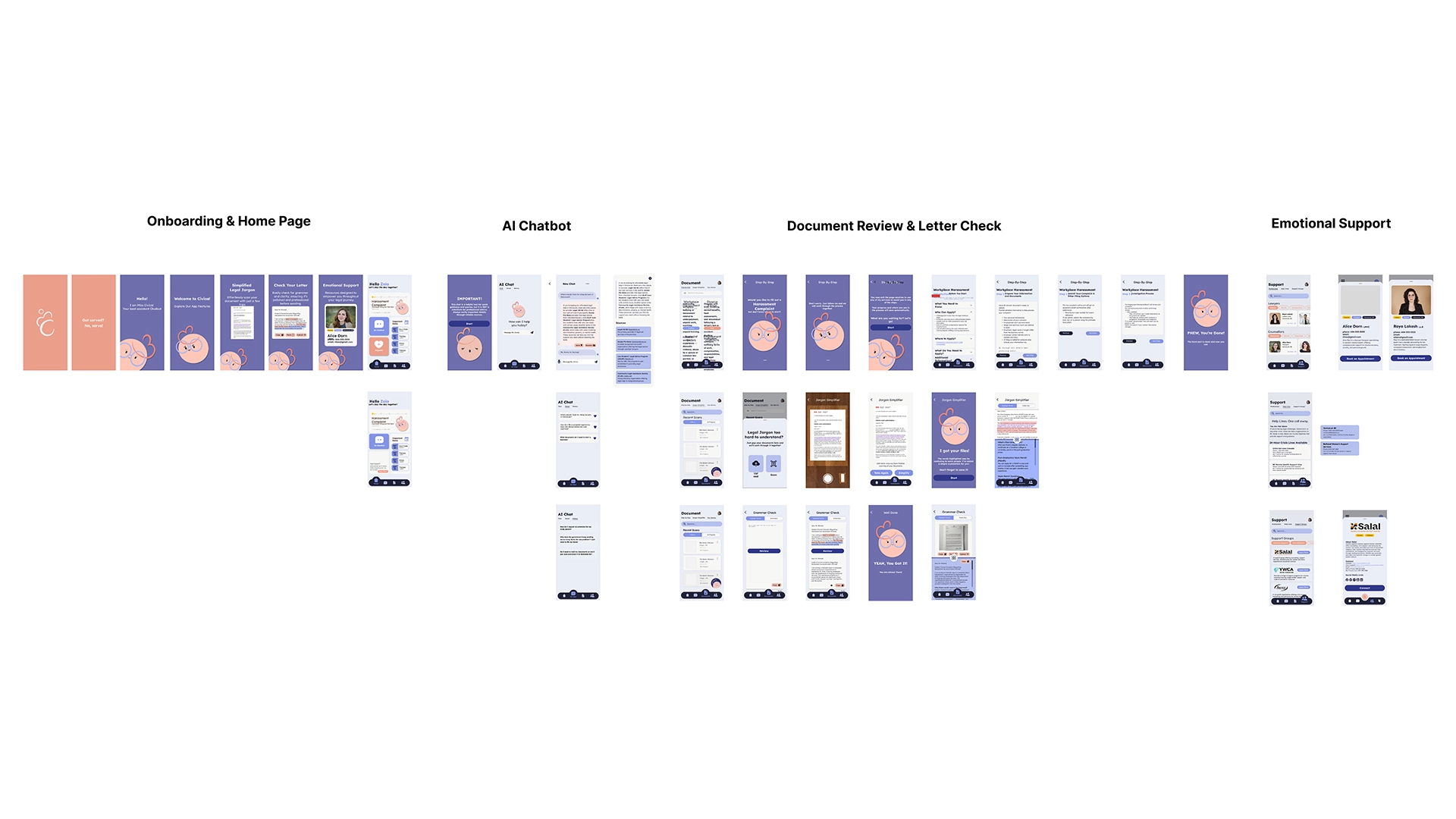
The initial wireframes beside the redesigned Civica 2.0 screens. Drag the handle to compare.
Branding
The logo was redesigned to balance emotional support with professionalism. Two intertwined hearts symbolize connection and solidarity, while the simplified form reinforces clarity and trust. The colour palette shifted to primarily blue tones after testing revealed that the original colourful interface reduced perceived credibility.
Information Architecture
Usability testing with four industry professionals revealed that key features were buried too deeply. Users struggled to locate primary actions, increasing cognitive load and friction. The IA was restructured to prioritize core tasks and reduce navigation depth, resulting in clearer pathways and a more intuitive experience.
App Walkthrough
Launching Civica
Civica launched on December 6, 2024, at BCIT's Telus Theatre. The team presented to peers and industry professionals and hosted live demos. The launch marked the completion of a full UX lifecycle, from research and problem definition through iteration, delivery, and reflection.
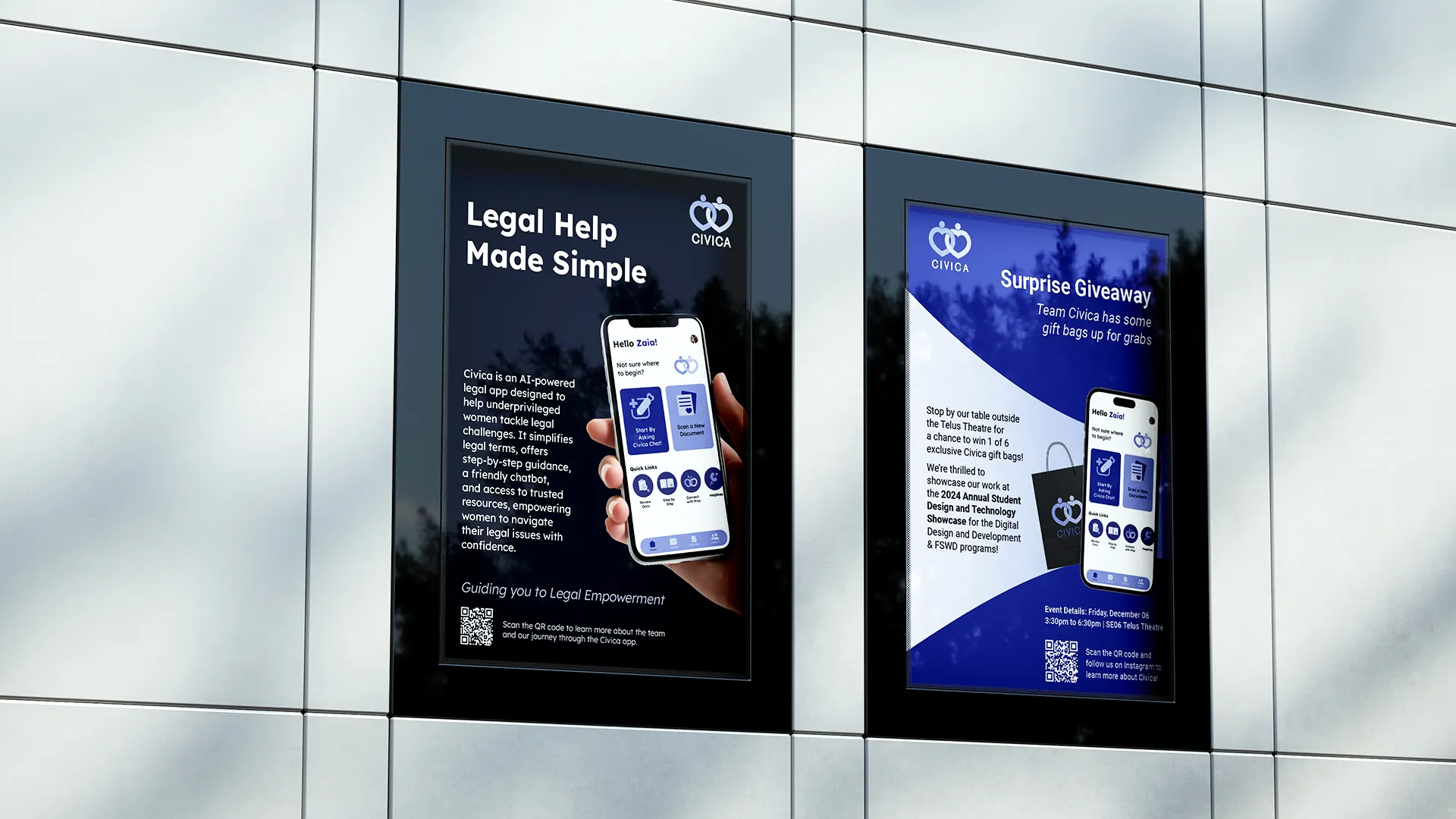
Promotional posters designed for campus display in the lead-up to presentation day.
Key Learnings
- Usability testing was essential for uncovering gaps between our design intent and how users actually experienced the product, especially the credibility a legal tool has to earn
- Designing responsibly can mean shielding users from the research process itself; we found ways to understand needs without asking women to relive difficult experiences
- Continuous research throughout development kept our assumptions in check and the work user-centred
- Clear ownership and open communication across an eight-person team translated directly into better collaboration and a stronger final product
Together, these reinforced the value of evidence-based decisions and iterative design.
What I'd Do Next
To keep improving Civica, I would focus on validating impact, iterating quickly, and scaling responsibly.
- Run follow-up usability testing with women actively navigating legal challenges to surface friction points and content gaps that emerge over time
- Collaborate more closely with legal professionals and advocacy organizations to validate content accuracy and maintain trust as the product evolves
- Refine feedback and progress indicators to reduce uncertainty during complex legal flows and reinforce user confidence
- Define and track success metrics such as task completion rates, repeat usage, and self-reported confidence to guide future iterations and measure real impact